On a bright and and beautiful January morning we met at the Douglas Fir Teaching Garden for a Buds, Branches & Bark walk with Julia Alards-Tomalin.

This was the third year we have partnered with Julia to run this free walk for the community. Julia is a winter plant expert and BCIT instructor. Together, with her students, she has written the award-winning open-source resource Buds, Branches, & Bark. So, we were excited to welcome Julia back to share her knowledge on winter plant identification!
On a table in the Douglas Fir Teaching Garden, Julia unpacked her collection of sticks and spread out an array of books on plant identification. Slowly, participants arrived, checked-in, enjoyed some hot tea, and perused the resources.
At 10am, Grace Nombrado, Executive Director welcomed everyone, before turning the event over to Julia Alards-Tomalin. Julia passed out a branch to each participant. For some, this was the first time they had been invited to examine closely the parts of a branch.
Julia proceeded to open this hidden world to us. She shared with us how the tip of the branch has an apical bud, where the tightly packed leaves or flower resides. The sides of the branch also has a number of smaller, lateral buds. For some plants, these buds are arranged opposite each other on the branch. While for other plants, the buds are arranged alternately on the branch. Julia reminded us of how leaves fall off a branch in the winter. When a leaf falls, it leaves a leaf scar on the branch. Looking closely at the leaf scar, she pointed out how you can also see tiny dots, which are the vascular bundle scars. They represent where the water and nutrient-conducting vascular tissues (xylem and phloem) connected the leaf to the stem before the leaf fell off.


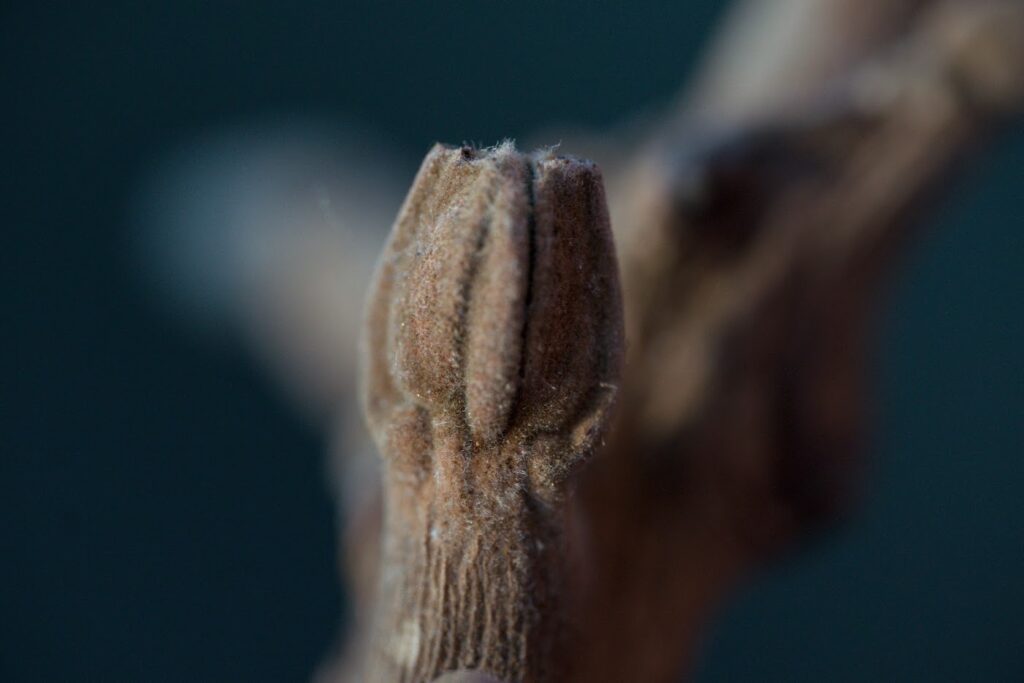


Gathering back her collection of branches, Julia then invited us to follow her down the Red Alder Trail, Champlain Heights Trails, for a plant walk.
Some things we discovered:
🌿Big leaf maple trees have fuzzy seed pods (samaras) that resemble helicopters when they fall
🌿Osoberry/Indigenous plum stems smell like cucumber when scratched
🌿Red flowering currant flowers attract hummingbirds
🌿oseanspray flowers (that looks like white ocean waves) hold onto their seeds through the winter
🌿Snowberry has white, non-edible berries that survive on the plant in winter
🌿Invasive black locust have very sharp thorns and seed pods that look like pea pods (but are not good to eat)
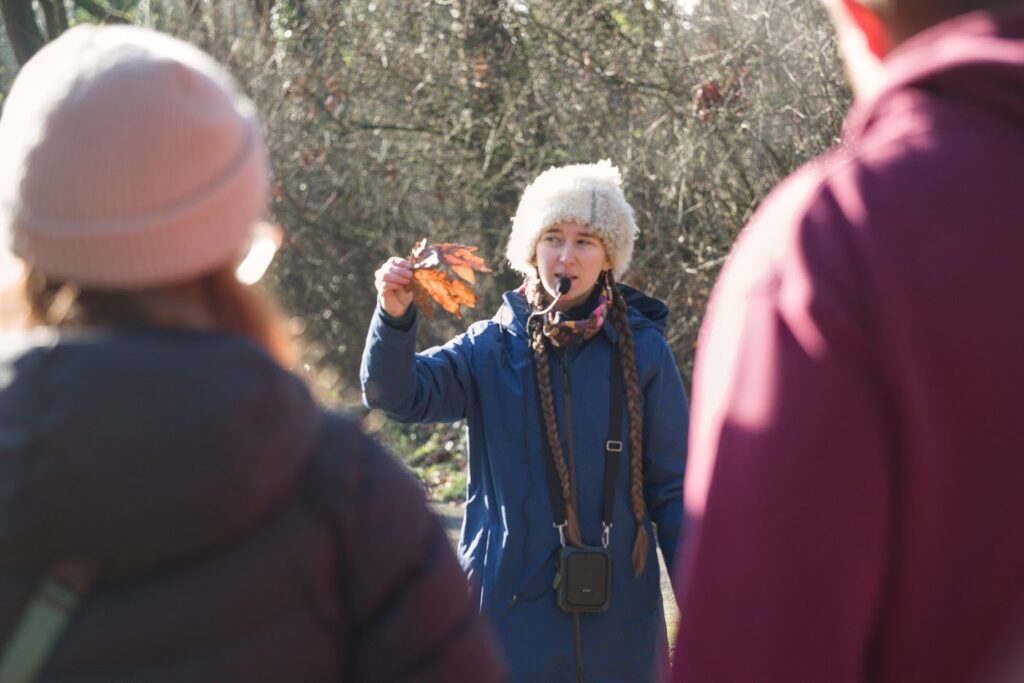


We are grateful to Julia for sharing her knowledge and for the 28 participants who came out to learn with us: Ada, Ana, Austin, Beth, Blayne, Brooke, Cassie, Coco, Colin, Connie, Declan, Ellen, Eric, Faye, Genivieve, Grace, Jaden, Jeannine, Joe, Kelly, Kira, Marie, Mel, Pamela, Rachel, Syla, Sung, and Tara.
Photos by Marie Pudlas & Grace Nombrado (Free the Fern Stewardship Society).